Physical Address
304 North Cardinal St.
Dorchester Center, MA 02124
Lindsey Stirling and ARKAI talk about their collaboration, debuting “High Noon” at the Gold Gala, and pushing string music forward.
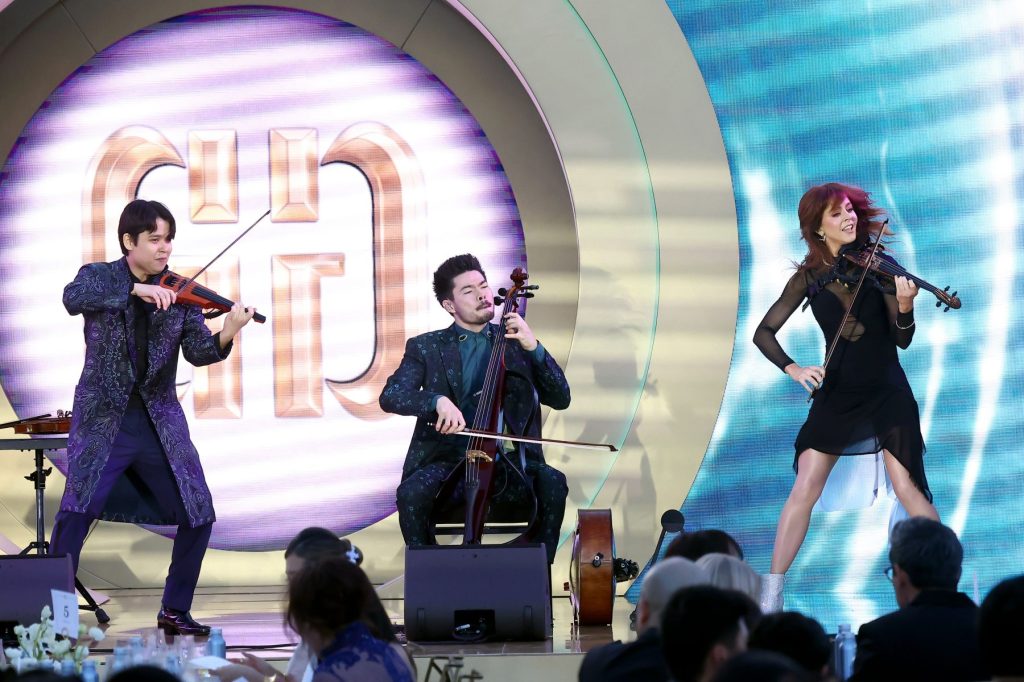
Two years ago, Lindsey Stirling was told to reach out to ARKAI, the New York-based electroacoustic string duo, and she didn’t hesitate. That was partly practical and partly instinctive. Stirling has spent much of her career working with producers who arrived with backing tracks already mapped out, and not many of them were eager to push back on her violin lines. With ARKAI, the dynamic changed. She was suddenly in a room with other string players.
“I was so excited to collaborate with someone who spoke my language,” Stirling tells Billboard. “We did a writing session, and afterwards, I was like, ‘That was so fun.’ My little string heart was exploding.”
ARKAI, made up of violinist Jonathan Miron and cellist Philip Sheegog, felt the same pull. The pair met as students at Juilliard and have been making music together for nearly eight years, but Stirling had long been a reference point. “Lindsey Stirling is an icon for the string community, because she showed us all what’s possible,” Miron says. “She showed us how we could take the old instrument, this violin, and bring it into mainstream sensibilities.”
That mutual recognition has turned into something sturdier than a quick creative connection. Since first linking up, the three have kept returning to the studio for writing and jam sessions, and last year ARKAI joined Stirling on her “Master of Tides” cruise, the multi-day music festival at sea. Most recently, the trio brought that chemistry to the Gold Gala, the annual event that gathers leaders from across industries to honor Asian Pacific and multicultural trailblazers. There, ARKAI and Stirling debuted original music together for the first time, unveiling a new take on ARKAI’s “High Noon,” from their Grammy-winning 2025 album Brightside.
Billboard spoke with Stirling, Miron and Sheegog about that performance, their process, and the next stretch of music they’re already thinking about.
At the Gold Gala, the setting mattered. The event centers API identities, and for Miron, being on that stage carried a specific kind of weight. “The Gold Gala is kind of like the Met Gala for the Asian community,” he says. “So to get invited and to be featured at an event like that was a dream come true. Philip and I kicked off with a medley of iconic Asian soundtracks, and then Lindsey joined us on stage, and that was our first performance ever with Lindsey playing an original song. All these things coming together, we are still pinching ourselves, it was a crazy experience.”
He also remembers the room itself. “And to look out into the audience, they were honoring people like Eileen Gu, and Jet Li. These are people we’ve seen on the screens. These are people we’ve seen kick ass at the Olympics. It’s unbelievable. And for us to be able to share our own music with these people is really an incredible honor.”
The song they chose was “High Noon,” and the decision to debut it there wasn’t random. On the original Brightside version, ARKAI had already built something large and cinematic, with explosive drums, towering synths and strings pushing up against all of it. But the core melody seemed adaptable, almost like a template for another version. “The original version, as many of our originals are, is like a massive cinematic IMAX experience,” Sheegog says. “But the melodic hooks were the things that we thought were the core, the DNA, of the song, something that can be translated. And so we asked, ‘What would happen if we kind of pulled [the hooks] a little bit towards Lindsey’s aesthetic? Make it a little bit faster, a little bit more dance pop-infused, a little more electronic-infused.’”
That reframing gave them a version that sits between both camps without flattening either one. “It’s the combination of our two worlds,” Sheegog says. “Hopefully when a fan listens to it, they say, ‘That’s Lindsey, but it’s also ARKAI, and it’s the two together.’ It feels like a really great first thing that we’ve now put out into the world at this performance, and now we’re just really excited to see how people respond to it.”
For Stirling, part of the appeal is simply being in a room where the instrument itself shapes the conversation. “It is unlike any other process I’ve ever done,” she says. “Usually you’re working with guys that have tracks or maybe they’re playing piano. But there’s something about the reverberation of strings together that actually makes your heart swell. Maybe I’m totally biased, because I’m a string player, but we’ll just start jamming, and it’s so fun because we’re not locked into a tempo. We’re just playing, we’re feeding off of each other’s melody. And we record the whole thing, so we’ll go back and find the parts we love and then we’ll turn them into refined melodies. It’s so fun to write with them. I would do it any chance I get.”
For ARKAI, the appeal is just as much about disruption as it is about chemistry. “Since Jonathan and I, for the last almost eight years, we’ve been a duo, we basically have only written with each other,” Sheegog says. “We write, arrange and produce all of our own music, so we know each other inside and out at this point. We know how each other think, our tendencies and how we play. But now we’re adding in another creative voice, who is at the same time very similar because Lindsey is a string player and we speak that same language. But she also has her own unique vocabulary, style, melodic and rhythmic tendencies and sensibilities. And so throwing that new element into the creative mix that we’ve been working in for years at this point, I think that was really, really fun, because it keeps you on your toes.”
So is “High Noon” a one-off? Not really. Stirling says more is coming, including live dates this summer in select cities across the U.S. and music the trio has already worked on for her next album, expected next year. “We’re gonna definitely do more together,” she says. “We are doing some tour dates this summer in select cities throughout the U.S., so we’ll get to perform it more together. And we actually worked on some music for my album that will be coming out hopefully next year. I would love to have their voices on it.”
She’s also been thinking about how individual voices come through in a track. “I always kind of wondered, when you hear a violin baked into a track, would you be able to differentiate mine from somebody else’s? And it’s so true that we really all three, not only does the cello have its own voice, we all play very differently,” Stirling says. “We have a different way of expressing, we play different kinds of melodies. Everybody has their own voice and I’m excited to not only have ‘High Noon’ to release this year, but also, next year, another track.”
That idea of voice, and of widening the lane for younger listeners, comes up again and again in the conversation. Stirling remembers growing up with limited options around what string music was supposed to be. “For me, it’s always been really important to give people that kind of an option,” she says. “I remember when I was a kid, there wasn’t much to play. It was classical music and maybe fiddle music, and there wasn’t really any other option. I remember I never wanted to perform at the talent show, because I was like, ‘Everyone will be bored.’ So now, I would love for kiddos to feel like they could play something that maybe feels a little bit more contemporary, and they can be cool.”
But she wants that lesson to travel farther than the string world. “I also really hope that it goes beyond just string players,” she says. “I hope that by being authentic and outside of the box, that people realize that whatever they do, they can they can reinvent themselves, they can step outside the lines, whether it’s being a feminist in a society that doesn’t support that or it’s sharing your poetry that’s really different. I just hope that everybody feels like they don’t belong in a box.”
Miron frames that same message as part of a larger lineage. “It means everything to me and Philip,” he says. “We feel so lucky to have had someone like Lindsey to look up to. She really did show us what’s possible. When we started doing our own thing, we were like, ‘You know what? If Lindsey can do it, maybe we can do it as well.’ And I think that’s what we hope to leave with with young people, young musicians. And exactly like Lindsey said, it really translates across so many different disciplines and professions, this idea that it’s okay to think outside of the box and do your own thing. I would argue that now more than ever, society is going to require that out of people. With automation and AI and all these different things, we’re going to need new ideas. We’re going to need people doing different things, and that’s how you stand out. And so what we hope is that maybe our stories can inspire a new generation of trailblazers.”
Sheegog adds that the duo’s own name points to that ambition. “The name ‘ARKAI’ actually comes from a Greek word that means ‘leaders,’” he says. “And that was something that when Jonathan and I first started out, that’s what we wanted to be in the in the world of string players, and the classical world writ large. But we see ourselves just as the latest links in the chain, a chain that goes back to Lindsey and her contemporaries, which then goes back another chain to the pioneers before that. It’s this endless chain and our greatest hope is that in a couple years, we’ll see some other young group who comes up and says, ‘Because I saw what you were doing, I had the courage to write.’ And I just echo everything that both Jonathan and Lindsey said, it’s so much more than music.”
ARKAI’s first Grammy win is another piece of that story, and they’re not pretending it won’t matter. Asked what the award might change, Sheegog jokes, “To the haters who are going to hate, hopefully, it just shuts some of them up.” Then he gets serious. “In some ways, there are always going to be barriers and roadblocks and gatekeepers who have their own opinions, but our hope is that it is a sort of stamp of approval that shows people are willing to listen to you. Our hope is that it helps people to have the conversation, to be open minded, to be like, ‘Okay, we don’t exactly know where to put you in in our boxes, right? You’re outside the box, but you’ve got this stamp of approval, so we’ll listen to you.’ And then hopefully, through that, they then discover something that they weren’t expecting.”
Miron says the award felt like evidence, not just validation. “We got interviewed right after the Grammy, and one of the things I said was that I really hope that for people who have faced rejection, we have been shunned from different rooms, that this is a moment to see what is possible when you follow your heart and you take risks,” he says. “I hope that it’s just another indication of what is possible. Philip and I are indie musicians, we’ve built everything pretty much from the ground up. Lindsey is the same. And so this is just an indication to anybody out there that, if you have a vision for something, a passion for doing something, if you put your heart into it, you can achieve anything.”
As for Stirling, the next year feels personal in a way that has surprised even her. She says she’s been writing a lot lately, and that the process, which used to be loaded with self-criticism, has started to feel lighter. “I’ve been writing a lot of music lately, and writing music, ironically, has always been really hard for me,” she says. “I’ve always really struggled with self negativity. And it’s been really exciting that, for the first time ever, I’m not doing that. I’m enjoying the process, as everyone always tried to tell me I can and that I don’t have to be so hard on myself. I don’t know what clicked. Maybe the years of therapy have finally actually set in. Maybe it’s the meditation. I don’t know what clicked, but I’m so happy right now, just in general.”
She’s not even waiting for the payoff to arrive before feeling good about it. “I don’t even have the fruits of the labor yet, I can’t even see if anyone likes anything I’ve written. But it doesn’t matter,” Stirling says. “I’m really just happy and I’m enjoying the journey, not just the destination. And so it makes me just really excited for not only this chapter, but what this chapter is going to lead to.”