Physical Address
304 North Cardinal St.
Dorchester Center, MA 02124
Carter Faith’s Cherry Valley earned an ACM album nod, and now she’s heading to Las Vegas for her first awards-show performance.
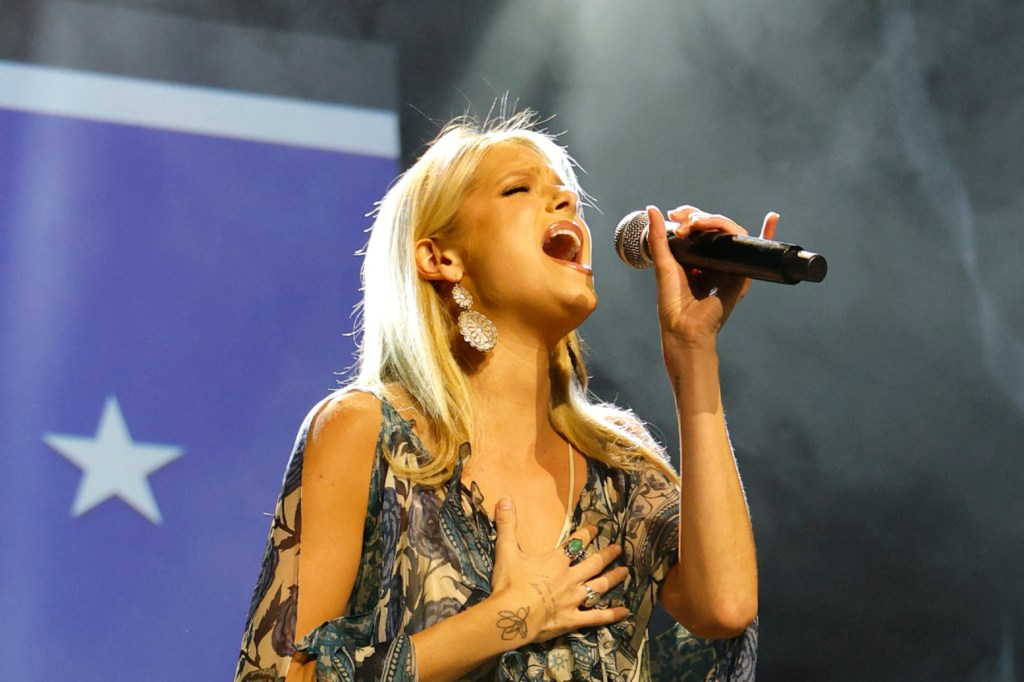
When Amazon asked Carter Faith to cut Faith Hill’s “Let’s Go to Vegas” for the Academy of Country Music Awards’ return to Nevada, she pushed back a flight to Europe by several days just to make it happen. For someone whose name has always carried a small, almost uncanny link to Hill, the offer felt personal in a way most promotional tie-ins don’t.
“When you’re younger, you feel connected to people for random things, and that was one of the things for me,” Faith says. “They asked me to sing that song. I was like, ‘Hell, yeah, I’ll cut it.’”
What she didn’t expect was that the bigger news would come while she was overseas. Faith had already been told she wouldn’t qualify for the ACM’s new female artist category because, by the Academy’s rules, an artist needs to have earned a top 50 single and she still hadn’t sent a song to radio. Then she learned that Cherry Valley had landed on the final ballot for album of the year at the ACMs, set for May 17. That was the real signal flare.
“I don’t have a hit on there, I don’t have a radio song, I don’t play these arenas,” she says. “But I feel like people just really connected with the music because it was different and said something that maybe a lot of people haven’t said in a while. Or ever.”
Cherry Valley takes its name, loosely, from a small community about 40 miles east of Nashville’s Music Row. Faith spotted the name on a road sign and imagined a place where a bright surface hides harder truths. That idea runs through the album, which moves through sex, drugs, religion, hypocrisy and alcohol with the confidence of a record that knows exactly how much it wants to reveal. The opening title track arrives with strings and a cinematic sweep, but the 15-song project drifts through folk, honky-tonk and traditional pop textures without losing its shape. It has the strange, slippery appeal of an audio version of Valley of the Dolls: cheeky, alluring and pretty to the point of danger.
Producer Tofer Brown, who has worked with Willow Avalon and Little Big Town, says the record’s references came from an older era of pop and country. “Carter and I listened to a lot of older music,” Brown notes. “We just are inspired by The Beach Boys, The Beatles, old country and all that. And we started noticing all these records that we were referring to, they all came out of, like, 1966, ‘67 and that era. The Beach Boys, Nancy Sinatra, and the sonics and the feel and the emotion and the heartbeat behind those records kind of inspired us.”
Even when the songs roam stylistically, the album stays unified by Faith’s voice, which can sound defiant and breakable at once, and by a production process that kept the same studio band on every track. If someone couldn’t make a session, the team waited until everybody could be in the room together.
“It was a band of brothers and sisters coming together with the same thesis statement and shooting for the same target,” Brown says. “I think that that really helped with the cohesiveness.”
Faith started writing songs at 16 in North Carolina, using music to work through the fallout of a breakup. From there, it turned into a path. She enrolled at Belmont University in Nashville to study composition, landed a songwriting deal with Universal Music Publishing Nashville and later signed with the company’s recorded music division, now called MCA. Even then, performing didn’t come naturally.
“I’ve always kind of grappled with the thought of people seeing me sing these songs and being on stage,” she says. “I had such bad stage fright — you know, going up on stage and singing your songs is vulnerable. I think I’ve come into myself as I’ve lived here.”
As Cherry Valley came into focus, Jessie Jo Dillon, who founded MCA’s Gatsby label, encouraged Faith to align with the imprint. Dillon and Brown gave her room to follow instincts that might have seemed left of center elsewhere.
“Me and Topher, we talked about it a lot,” Faith says. “We were like, ‘This should be the record that, if we never get to make another record, that this is something we’re proud of.’ And I really try to do that with every single decision. I just want to do it all up and not play it safe.”
That instinct paid off. Cherry Valley became a critical favorite and clearly got the attention of ACM voters, sneaking onto the final ballot in a field that usually leans hard toward hit records. Gatsby is already pushing the project further with Cherry Valley Forever: The Deluxe Album, due July 24, which adds five new songs. None were part of the original sessions, but the album’s loose community idea made the expansion feel natural enough.
“Just like any town can grow, Cherry Valley can grow,” Brown says. “We allowed ourselves to be like, ‘Oh, we might be adding a new neighborhood,’ rather than being like, ‘How does this fit so perfectly?’ If you do that, you’re going to lose your mind, and you’re going to overthink things.”
For now, the original album is sending Faith to Las Vegas for her first awards-show performance, with Brown in the backing band behind her. The irony is hard to miss: she’s still calling herself the new girl, even as an ACM nomination makes her feel more visible than ever.
“I’m the new girl,” she says. “I’m nervous, and I don’t know these people that I’m going to be backstage with. I’ve heard about them, I’ve heard their music on the radio, I’ve seen them, and I’m a big fan of them, but I do feel like I’m kind of stepping into a world I’m not super a part of yet. That’s a little scary.”
And still, she’s already thinking beyond it. Faith is considering 20 to 30 titles for the next record, fully aware that the rules of the game will shift now that Cherry Valley has found an audience. She made that album without knowing who would hear it. Now she has listeners, inside the industry and out, and the temptation to second-guess herself is right there.
“I see a lot of people become caricatures of themselves, and I really try not to do that,” she says. “That’s kind of what I love about my favorite artists, is that they still feel like themselves.”